
What Is Physiologic Flexibility?
Physiologic Flexibility is the body's capacity to respond appropriately to physical, metabolic, neurologic, recovery and lifestyle stressors and then recover toward baseline.
Think of health less like a fixed destination and more like a range. Your body should be able to increase its output when more is required and decrease it when the demand is over.
You should be able to exert yourself and recover. Eat and regulate energy. Encounter stress and then relax.Lose sleep occasionally without completely falling apart. Move through different positions and physical demands. Adjust to changes in activity, nutrition and environment. The goal isn't to eliminate stress from your life. The goal is to build a body that is better prepared to handle it.
Physiologic Flexibility
Health Isn't Just the Absence of Symptoms. It's the Capacity to Adapt. Your body is constantly adapting. A workout challenges your muscles. A meal changes your metabolism. A stressful conversation activates your nervous system. A poor night of sleep changes how you feel and perform the next day. A healthy, resilient system isn't one that never experiences stress. It's one that can respond to a challenge, adapt appropriately, recover, and return toward baseline. We call this Physiologic Flexibility. At Dynamic Naples, Physiologic Flexibility provides a framework for looking beyond isolated symptoms and asking a different question: How well is your body adapting?
Why You Can Feel "Off" Even When Nothing Seems Obviously Wrong
Many people who come to Dynamic Naples don't have just one complaint. They may experience combinations of: Fatigue. Recurring pain. Poor recovery. Brain fog. Digestive problems. Dizziness. Changes in exercise tolerance. Difficulty losing or maintaining weight. Poor sleep. Blood sugar fluctuations. Or simply the feeling that their body doesn't tolerate stress the way it used to.
Traditional healthcare often has to divide these concerns into separate systems. That is sometimes necessary. Symptoms can require specific medical evaluation and treatment. But there is another useful question to ask: Could several of these problems reflect a reduced capacity to adapt to stress and recover from it? Physiologic Flexibility gives us a framework for exploring that question without assuming that every symptom has a single cause.
The Adaptation Cycle
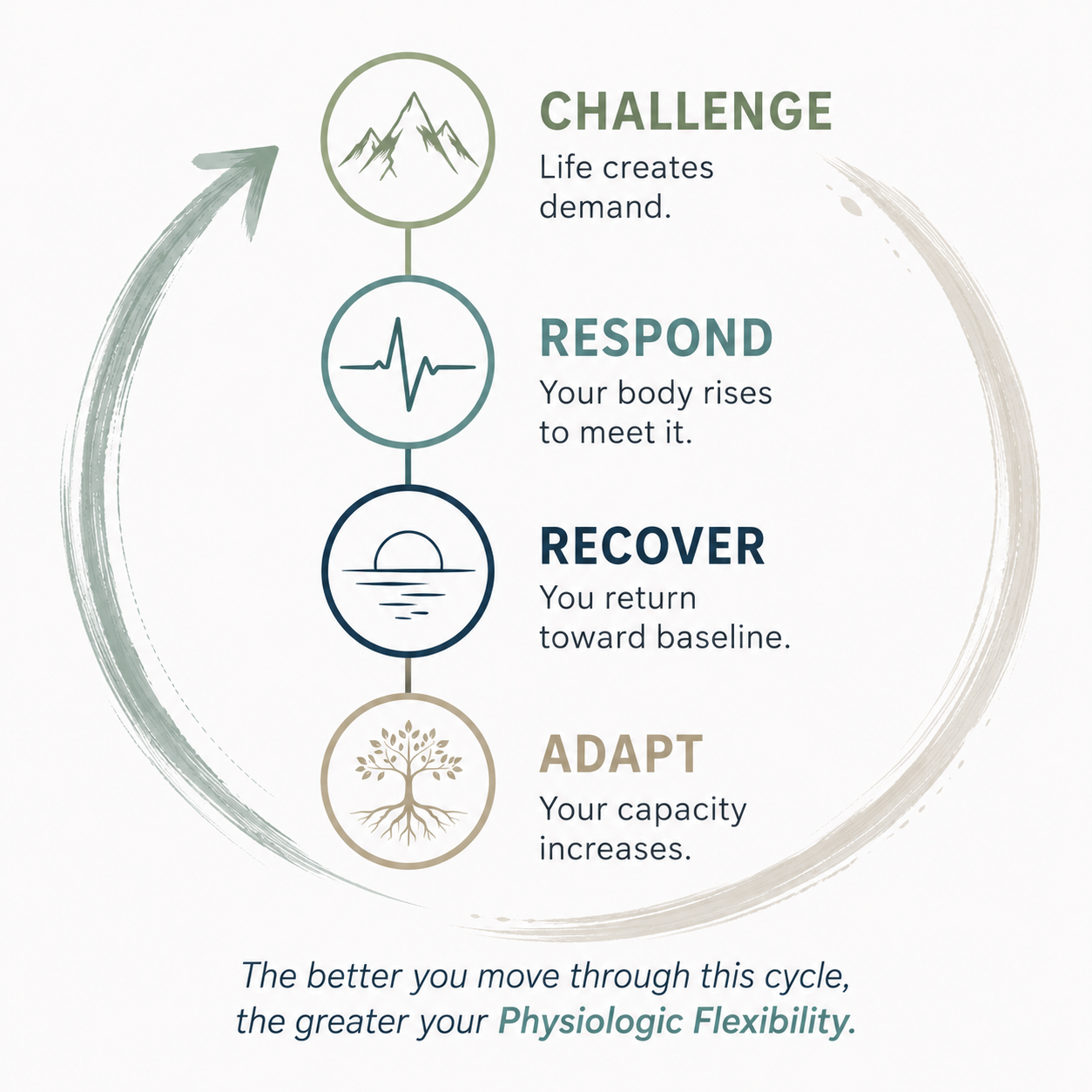
Nearly every system in your body follows some version of the same process: Challenge → Response → Recovery → Adaptation
Exercise provides a simple example. You challenge the body with resistance training. Heart rate rises. Muscles generate force. Energy demand increases. The nervous system becomes more active. Then the workout ends. Heart rate decreases. Energy stores are restored. Tissue repairs. The nervous system shifts toward recovery. With an appropriate challenge and adequate recovery, your capacity can increase. The same general principle applies across many areas of physiology. The ability to move between states may be just as important as the state itself.
The Five Pillars of Physiologic Flexibility
We organize Physiologic Flexibility into six interconnected areas.
1. Movement Capacity
Can your body tolerate the physical demands you place on it? Movement capacity includes mobility, strength, coordination, balance, tissue capacity and movement variability. The goal isn't simply to move without pain while sitting in a treatment room. It's to build enough capacity to tolerate the activities that matter to you.
2. Stress & Nervous System
Your nervous system should be capable of activation and recovery. Stress itself isn't inherently bad. Exercise is a stressor. Work is a stressor. Learning is a stressor. The question is whether your system can appropriately increase its response when necessary and then shift back toward recovery when the challenge passes. Breathing, perceived stress, autonomic regulation, focus and recovery from stressful events can all provide insight into this pillar.
3. Energy & Metabolism
Your metabolism constantly adjusts to changes in food intake, activity and energy demand. Metabolic flexibility includes stable energy, glucose regulation, fuel utilization, appetite patterns and the ability to tolerate changes in meal timing and physical activity. Rather than chasing a single glucose reading or metabolic marker, we want to understand the larger pattern of how your body responds.
4. Gut & Immune Resilience
Your gastrointestinal and immune systems interact with virtually every other system in the body. Digestive tolerance, bowel regularity, food response and immune burden can influence how someone feels and recovers. The goal isn't a "perfect" gut. It's a gastrointestinal system capable of tolerating reasonable variation without every small disruption creating a major or prolonged response.
5. Sleep & Recovery
Challenge only creates adaptation when the body has an opportunity to recover. Sleep quality, circadian habits, soreness, training recovery and readiness for the next physical or mental demand all contribute to your overall adaptive capacity. Sometimes the answer isn't another intervention. Sometimes the system needs greater recovery capacity.
The Dynamic Flex Method™
Understanding the problem is only the beginning. At Dynamic Naples, we use a five-step framework for applying the principles of Physiologic Flexibility.
1. Measure
Establish a baseline. Depending on the individual, this may include health history, movement assessment, relevant clinical measures, lifestyle patterns and the Dynamic Flex Index™.
2. Identify Constraints
Instead of chasing every symptom independently, identify which areas appear to be limiting the body's ability to adapt.
3. Build Capacity
Use appropriately selected movement, recovery strategies, nutrition and lifestyle education, and clinical interventions when indicated.
4. Expose & Adapt
The goal isn't to protect the body from every challenge. It's to progressively expose the system to appropriate challenges so that greater capacity can develop.
5. Reassess
Measure again. What changed? What didn't? What can you tolerate now that you couldn't tolerate before? The plan evolves based on the response.
How Flexible Is Your Physiology?
One reason health can become frustrating is that we tend to measure individual snapshots. A lab value. A glucose reading. A heart rate. A pain score. A number on the scale. Those measurements can be useful, but they don't always tell us how well the system responds to change. That's why we created the Dynamic Flex Index™.
The Dynamic Flex Index is a brief educational self-assessment designed to help you look at patterns across several areas of adaptability, including:
• Sleep & Recovery
• Energy & Metabolism
• Movement Capacity
• Stress & Nervous System
• Gut & Immune Resilience
Your results can help identify areas where your adaptive capacity appears strongest and areas that may deserve more attention. The Dynamic Flex Index is an educational wellness tool and is not a diagnostic test or validated medical instrument.
The Goal Isn't Perfection. It's Capacity.
Physiologic Flexibility changes the question. Instead of only asking: "How do I get rid of this symptom?"
We can also ask: "What capacity does my body need to build so this challenge becomes easier to handle?"
That shift can change how we think about pain, exercise, metabolism, stress, sleep, recovery and long-term health. Because ultimately, resilience isn't about avoiding every stressor. It's about becoming more capable of adapting to them.
Build Your Physiologic Flexibility
Dynamic Naples combines Physical Therapy, Functional Medicine and performance-focused care to help people better understand the factors that may be limiting their ability to move, recover and adapt. Your starting point depends on what you need.
I Want to Understand My Baseline
Take the Dynamic Flex Index™ and identify the areas that may deserve the most attention.
I Have Symptoms or Performance Problems
Work with Dynamic Naples to evaluate the physical and physiologic factors that may be contributing to your limitations.
I Want to Build Greater Resilience
The Resilient Blueprint™ is our educational program designed to teach you how to apply the principles of Physiologic Flexibility to your own life.
Physiologic Flexibility FAQ’s
What does physiologic flexibility mean?
Physiologic Flexibility describes the body's capacity to respond appropriately to changing demands and recover toward baseline after the challenge has passed.
Is Physiologic Flexibility a medical diagnosis?
No. Physiologic Flexibility is a framework for understanding adaptability across multiple areas of health and performance. It is not a medical diagnosis.
Can physiologic flexibility be improved?
Many components that contribute to adaptive capacity can change with appropriate training, recovery, nutrition, sleep, stress-management strategies and healthcare when indicated.
How do I know which area I should work on?
Start by looking for the constraint. Your movement, recovery, energy, stress response, digestion and broader health history can help identify which areas deserve the most attention. The Dynamic Flex Index™ is one educational starting point.
Is Physiologic Flexibility the same as metabolic flexibility?
No. Metabolic flexibility is one component of the broader Physiologic Flexibility framework. Physiologic Flexibility also considers movement capacity, nervous-system adaptability, gut and immune resilience, sleep and recovery, and hormonal/systemic regulation.
Health Isn't Static.
Your environment changes. Your activity changes. Your nutrition changes. Your stress changes. Your body changes. The question isn't whether you can eliminate every challenge. The question is how capable your body is of adapting when the challenge arrives. That's Physiologic Flexibility. Measure it. Build it. Challenge it. Reassess it.