Questions? Or do you want me to blog on a specific topic? Email me at: drchris@dpt.services
Want to get the latest blog posts? Sign up for the Thursday Three Newsletter below.
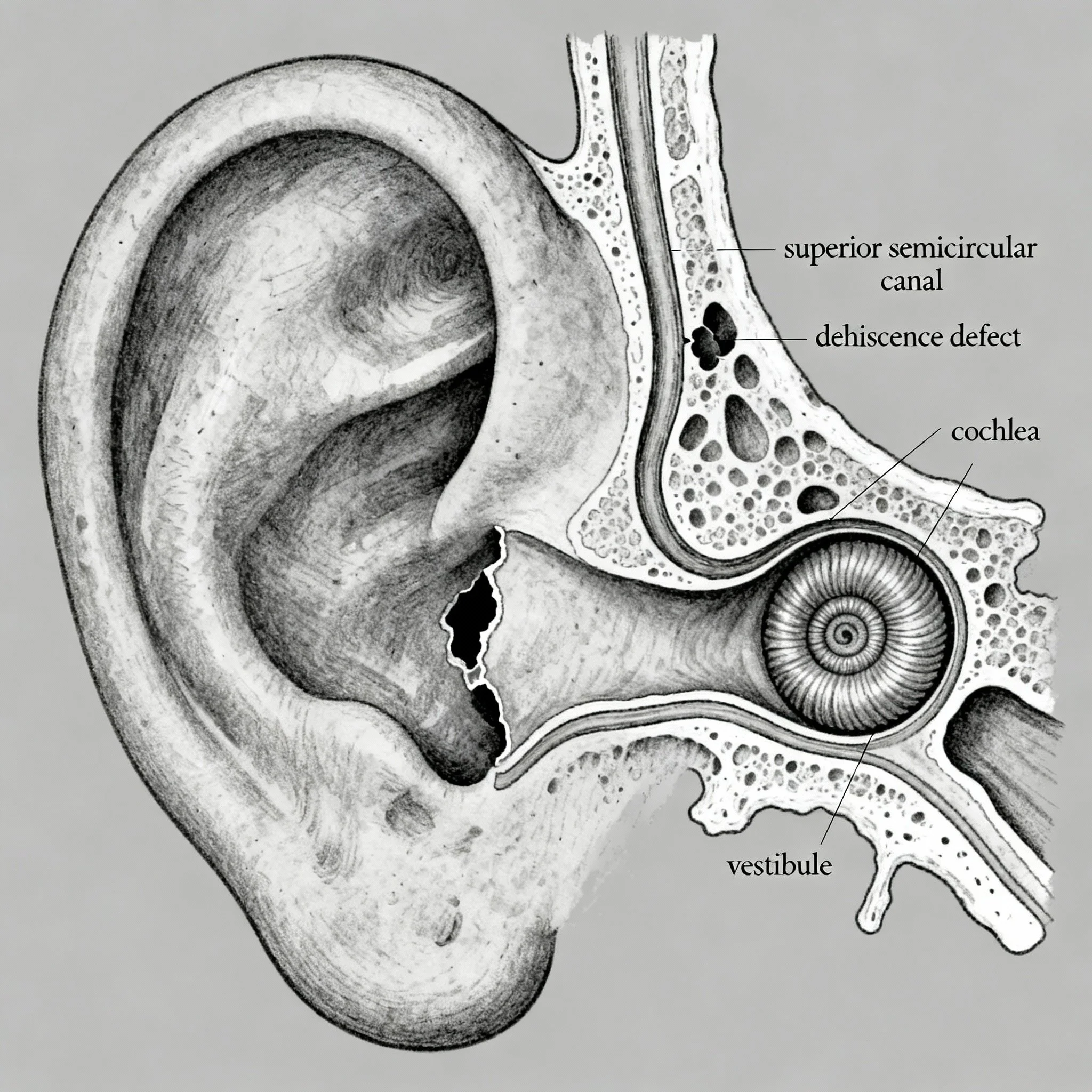
Superior Canal Dehiscence (Vertigo)
Superior canal dehiscence (SCD) is a rare disorder of the inner ear that can dramatically affect both balance and hearing. It results from a thinning or a hole (dehiscence) in the bony covering of the superior semicircular canal, one of the three semicircular canals responsible for detecting head motion and spatial awareness.
SCD occurs when the bone overlying the superior semicircular canal is absent or abnormally thin, creating a "third window" in the inner ear that disrupts the normal flow of sound and pressure. This aberration causes the inner ear to transmit signals in ways it's not supposed to, often making everyday sounds seem amplified or distorted.
The symptoms of SCD are a unique mix of auditory and vestibular (balance) disturbances:
Dizziness triggered by loud noises, pressure changes, coughing, or sneezing
Autophony, which is an unusually loud perception of one's own voice or internal sounds like heartbeat and even eye movement.
Hearing loss, which might be conductive in nature.
Tinnitus, often described as ringing or pulsing in the ears.
Sound sensitivity and a sense of disequilibrium, especially with sudden movements or exertion.
These symptoms can be intermittent or chronic and are often so unusual that patients may see multiple specialists before receiving a correct diagnosis. As far as we know, SCD develops from a congenital thinning of the bone over the canal, which may be worsened by minor trauma or increased intracranial pressure later in life. It's not generally something patients cause through lifestyle or activity; rather, it’s often a developmental anomaly.
Diagnosis is typically confirmed by a combination of clinical assessment and imaging:
High-resolution CT scan of the temporal bone to visualize the defect.
Special vestibular evoked myogenic potential (VEMP) tests to assess the function of the inner ear and help differentiate SCD from other ear disorders.
Treatment Options
Treatment depends on severity:
More severe or disabling cases might require surgical intervention. The most common procedures involve resurfacing or plugging the dehiscent canal, generally performed through a middle fossa craniotomy or transmastoid approach.
Physical therapy may help manage symptoms. There is a reflex called the vestibular ocular reflex (VOR) that can become dysfunctional in many types of vertigo. It is responsible for keeping your gaze stable as you move your head. There are corrective exercises that can be done to improve this reflex.
If you or someone you know is experiencing unexplained vertigo or unusual hearing symptoms, give us a call and we can help you get on the right path.
Dizziness and the Vestibular Ocular Reflex (VOR)
There are a lot of causes of dizziness. Dizziness is a vague word though, and can be used to describe a variety of symptoms. So when a patient tells me they are dizzy, I first clarify what type of dizziness because that gives me good insight to the problem at hand. There is the room-spinning dizziness that is most commonly associated with BPPV (the crystals in the ear). Then there is light-headed dizziness which may be a blood pressure issue, amongst other things. Then there is that feeling of being “off-kilter”, or a “wooziness”. This is the type of dizziness this blog will address.
The vestibulo-ocular reflex (VOR) plays a crucial role in maintaining stable vision, particularly when the head moves. Imagine you're riding in a car, and you’re looking out the window at a tree. Now, when the car turns, you can still see the tree clearly, right? That’s because your eyes quickly adjust to keep the tree in focus, even though your head is turning. This reflex allows your eyes to adjust quickly and accurately in response to head movements, helping you maintain focus on an object despite the changes in your head's position. When there’s an issue with this reflex, it can lead to a condition called VOR hypofunction.
VOR hypofunction refers to a decrease in the function of the vestibulo-ocular reflex. In simpler terms, it means that the system responsible for stabilizing your gaze during head movement isn’t working properly. This results in blurred vision, dizziness, and difficulty focusing on objects when you move your head.
The VOR works by detecting head movement via the vestibular system, which is part of the inner ear. By the way, this has nothing to do with hearing. The vestibular system sends signals to the eye muscles to adjust the position of the eyes, helping you maintain a stable visual field. When this process is disrupted, you may experience a variety of symptoms, especially when turning your head or performing activities that require quick eye movements.
I often liken this to a boat with 2 engines, one is 150 horsepower and the other is 50 horsepower. It would be hard to drive that boat straight. VOR hypofunction is a miscalibration of the reflex. This can cause blurred vision, difficulty focusing on an object, motion sensitivity, nausea, and impaired balance. You may even notice that you are veering to one side when walking.
VOR hypofunction often occurs secondary to another issue. It can be as simple as dehydration. It often happens with someone who has been dealing with BPPV for a long time. Or, if you’ve become sedentary and are just not using the reflex much. Like a muscle, it atrophies in a sense. The good news is that it’s just a matter of recalibrating the reflex to fix it. This can be done with some simple exercises called “gaze stabilization”.
If this sounds like you, I’d recommend getting on a call:
We’ve also built an at home, DIY program. You can learn more about it here:
A Cause of Dizziness - Meniere’s Disease
There are many causes of room-spinning dizziness, so it’s important to identify other symptoms to be able to correctly diagnose the cause. Meniere’s disease is characterized by room-spinning dizziness provoked with head position change and can last hours to days. It can also be accompanied with hearing loss, a sense of fullness in the ears, and ringing in the ears.
There are many causes of room-spinning dizziness, so it’s important to identify other symptoms to be able to correctly diagnose the cause. Meniere’s disease (you may hear it called endolymphatic hydrops) is characterized by room-spinning dizziness provoked with head position change and can last hours to days. It can also be accompanied with hearing loss, a sense of fullness in the ears, and ringing in the ears.
This is caused by an excessive amount of endolymph; the lymphatic fluid that flows through the inner ear. The exact cause is unknown, but it’s a condition of “too much”. The normal production or reabsorption of fluid has been altered. Some theories as to why this occurs are an abnormal immune response, viral infection, or a genetic predisposition.
Another interesting finding is that there is a strong correlation between Meniere’s disease onset occurring with changes in carbohydrate consumption. After a meal, insulin is released to usher carbohydrates out of the bloodstream and into muscle cells and into the liver. Under normal circumstances, insulin has a dilating effect on blood vessels. However, with a diet that is chronically high in carbohydrates, one will develop insulin resistance. Now the cells stop responding to insulin and it has an opposite effect on the blood vessels; it constricts them. That is the association between diabetes mellitus (insulin resistance) and high blood pressure. Meniere’s disease is basically a high pressure system (I think of it like a traffic jam, too many cars, not enough highway). In 2005, D’Avila and Lavinsky found that in a sample of 64 patients with Meniere’s, 72% had hyperinsulinemia (when one is insulin resistant, the pancreas secretes more insulin - this is hyperinsulinemia).
The current conservative recommendations is avoidance of salt, caffeine, and alcohol, and increased hydration in an attempt to restore normal pressure. However, there is not high levels of evidence as of yet demonstrating the effectiveness. If that doesn’t work, oftentimes medicines such as meclizine or diazepam are administered to dampen the symptoms. Some patients are given gentamicin, an antibiotic. This is a known ototoxic drug and can damage the hair cells of the inner ear. So you may be swapping an intermittent problem with an irreversible one.
I hope to see randomized control trials looking at low carbohydrate diets as a way to address Meniere’s disease. There is plenty of case studies and anecdotal evidence for it, however we just don’t have the evidence as of yet. It would seem to make sense that treating the underlying issue of a high pressure problem would be superior to treating the symptoms.
Regardless, many patients are left with some balance problems and sometimes a disturbance in the vestibular ocular reflex; the reflex that allows you to keep your gaze stable. These problems are both easily treatable with physical therapy. If this sounds like you, let’s get on a free call to see if we can determine the cause.
Reference:
D'Avila, C., & Lavinsky, L. (2005). Glucose and insulin profiles and their correlations in Ménière's disease. https://pubmed.ncbi.nlm.nih.gov/16639918/.
Dizziness - Labyrinthitis
If you’ve had a recent bacterial or viral infection, and then become dizzy, it may be due to labyrinthitis. The inner ear has a membranous labyrinth which can become inflamed. This will usually cause dizziness, nausea, vomiting, hearing loss, and ringing in the ears. The dizziness will usually be described as room spinning and can last for days.
The most common cause of labyrinthitis is an upper respiratory tract infection. Ramsay-Hunt syndrome can cause it too, which is the herpes zoster virus (shingles) attacking the facial nerves. This will cause pain, hearing loss, and a rash in the mouth, face, neck, and scalp, and cause temporary facial paralysis. In some rare cases, autoimmune disorders can also trigger labyrinthitis.
The good news is that the prognosis is generally good, lasting for 72 hours to up to a few weeks. Patients will be instructed to hydrate, and if it’s bacterial, they’ll be given antibiotics. Some patients may need medical management depending on severity of symptoms, and may include steroids or antihistamines. However, most people will develop a VOR hypofunction as a secondary result. VOR hypofunction means that the vestibular ocular reflex isn’t working right. This reflex allows your gaze to remain fixed on an object as your head moves. There is a progression of exercises like the one below to address this:
If this sounds like you, let’s get on a call and see if our dizziness program is the right fit for you:
The Many Causes of Dizziness
When I have a patient that wants to know what to do about their dizziness, the first thing I want them to do is describe how it feels without saying “dizzy”. Dizzy is a blanket description that can mean anything from lightheaded to room spinning dizziness. It may sound callus, but I always hope for room spinning dizziness.
There is a good reason for that...room spinning dizziness that occurs with head turning and lasts for about a minute, is most likely BPPV. That is benign paroxysmal positional vertigo. If you’ve heard of the “crystals in the ear”, that is BPPV. The reason I hope for this type of dizziness is that it is incredibly easy and effective to treat. The best part is that it usually takes 1 visit, sometimes 2.
There are videos on YouTube describing how to treat this, but I highly recommend you don’t attempt it on your own because you may get lucky and fix it, but you also can get unlucky and create a second problem. Let’s have a look why:
This is the inner ear. There are 3 semicircular canals on both sides of your head. Inside the canals is fluid, and at the base of the canal, there is something called a cupula. On the cupula are otoconia (the crystals) that anchor hair cells. When you turn your head to one side, the fluid pushes the hair cells to one direction (and the opposite direction on the other side). This connects to a nerve and gives the brain information. When the crystals are out of place, it throws off the whole mechanism. The treatment aims to roll the head in a manner that gets them back to the cupula where they are reabsorbed. Now, the problem is that the canals have a common area (the utricle). If you attempt this treatment by yourself, you run the risk of placing the crystals into another canal. Now you have two problems and the dizziness will intensify.
Now, what if it’s not this type of dizziness? Well, that will probably require a thorough evaluation. It can be Meniere’s disease, labrynthitis, vestibular neuritis, a perilymphatic fistula, an acoustic neuroma, or VOR hypofunction. That’s a lot of jargon, and it’s not an exhaustive list, but the last one, VOR hypofunction, is worth some description as it’s usually a repercussion of BPPV. When someone has been dealing with BPPV, they don’t want to turn their head out of fear that it’ll provoke the dizziness. This lack of movement will sometimes lead to VOR hypofunction.
VOR stands for the vestibulo-ocular reflex. Your ability to maintain your gaze on an object while turning your head is due to this reflex. If you’re not turning your head and using the reflex, it can become “miscalibrated”. Luckily, there is an easy exercise that can retrain the reflex. Now I’d make sure to get evaluated first to make sure it isn’t something more serious. I also wouldn’t do this if you still have unresolved BPPV. Once cleared, here is how you can start to retrain the reflex:
Please subscribe to our YouTube channel for more great content
Want more information? Let’s get on a call and discuss your dizziness: