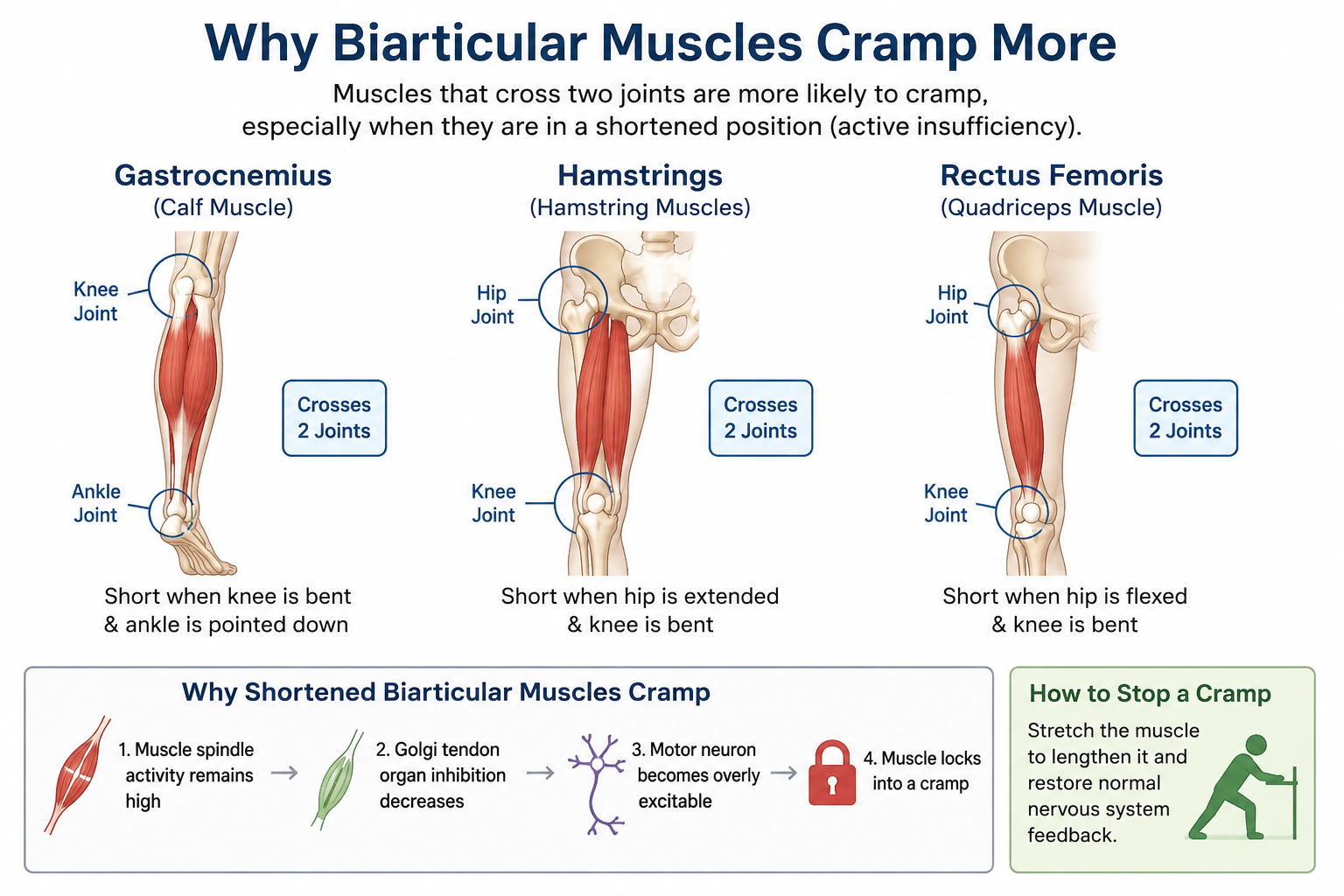
There are certain muscles that just seem prone to cramping, particularly the hamstrings and calves. There are several reasons why they cramp (which we’ll cover), but one of them is positional. It’s called active insufficiency.
Active insufficiency is when you shorten a muscle on both ends at the same time. In this position, the muscle can’t generate much force so the nervous system increases neural drive. Technically, this is the muscle spindle increasing activity. We also have Golgi tendon organs that inhibit activity, which become less efficient in a shortened position. So on one side of the coin, you have increased activity, and the other side, decreased inhibition. This is the recipe for a cramp.
Many people worry that cramps can cause muscle tears. This is not true. In most instances, cramps are harmless besides the discomfort they leave us with. It can be a signal that there is something else off balance, and that’s usually an electrolyte and/or hydration problem. Magnesium deficiency is the most common deficiency when it comes to electrolyte imbalance, but sodium deficiency is common as well. Particularly in warmer climates, if you are exercising outside, you are dumping both water and electrolytes. So it becomes important to add the electrolytes to your water, otherwise you dilute your system and that causes misfiring of muscles, aka cramps. This is a condition called hyponatremia.
So what causes active insufficiency of certain muscles? Well, it happens to biarticulate muscles, otherwise known as two joint muscles. The hamstring crossed two joints, the hip and the knee. The calf crosses the knee and the ankle. That means that you can affect the tendon on both ends with those two joints, which sets them up for active insufficiency.
Let’s take the hamstring for example. At the hip, the hamstring extends the hip. It also flexes the knee. So if you are in a position of hip extension and knee flexion at the same time (picture a hip flexor stretch), you are likely to get active insufficiency. The calf flexes the knee and plantar flexes the ankle. So if you combine those motions…calf cramp.
Here is a way to avoid that cramp:
There are other muscles that are biarticulate, but we just tend to not get into the positions that would cause active insufficiency. Let’s take the biceps for example. It flexes the shoulder and elbow. So if you were to flex your bicep by bending your elbow maximally, then keeping that position, and raise your arm overhead (not recommended), you’ll get a severe bicep cramp.
To avoid cramping, keep your body hydrated and make sure to replenish electrolytes, both prior to exercise and after. Keep your muscles limber, and that should set you up to get into positions like we mentioned above, without cramping.