How Sleep Changes Pain
Early in my career, I noticed a pattern. Everyone that ended up on my table was sleeping poorly. At first I thought it was strange; why is everyone in this town sleeping so bad? Then I realized it wasn’t everyone, it was those that were in therapy for pain. Was pain inhibiting their sleep, or was pain augmenting their sleep? It turns out, both. It’s a vicious cycle.
So I started asking my patients to track their sleep and their pain. Sure enough, it was almost a 1:1 pattern. Pain would wax and wane with the quality of their sleep. I think this is an important concept because many patients would feel they were getting worse and some damage had occurred in bed (very hard to do by the way). When I connected the dots for these patients, there was less panic and they tended to get better faster.
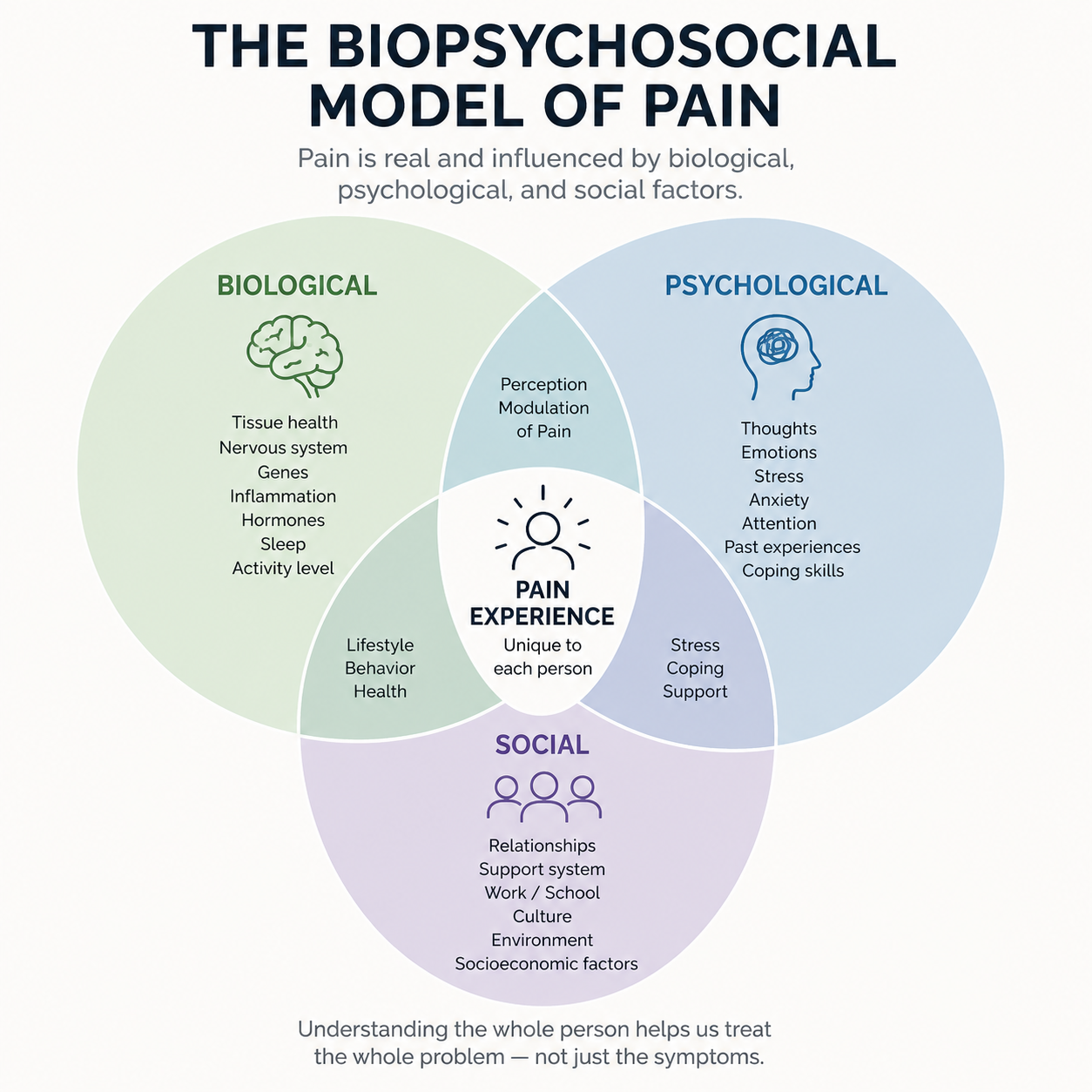
Pain is very complicated and we’ve been stuck with this biomechanical model of pain, or what is known as, “the tissue is the issue”. There is a better model for understanding pain that was proposed in the 70s but somehow hasn’t become mainstream. It’s called the biopsychosocial model of pain:
There’s a great story I heard on this podcast that was called “the tale of two nails” that illustrates this model well. In the first story, a construction worker jumps off a beam and lands on a long nail sticking upright. It pierces right through his workboot and he sees the nail stick out of the top of the boot. He screams in agony, gets rushed to the ER and gets heavily medicated. When the physician removes his boot, they realize it was a miss. The nail went between the webbing of his toes; no tissue damage.
The second story is with another construction worker. He’s using a nail gun. Nail guns can sometimes shoot more than one nail at a time and in this case when he pulled the trigger, one nail hit the target, and unbeknownst to the worker, a second nail shot out and went through his jaw and perforated the roof of his mouth with some of the nail impinging on his brain. He didn’t realize it though and only saw the first nail hit the target. He continued to work for days until he felt a mild toothache which is when his physician discovered the nail.
One nail with no damage - extreme pain. Another with extensive damage - barely even felt. How is this possible? Context is everything. The nervous system is a learning machine and its main goal is to keep us alive. When it perceives a threat, it produces a pain signal. Pain is an output of the brain, not an input of a local tissue.
The equation to becoming more resilient is: Stress + Recovery = Adaptation. Stress here can also mean challenge, or stimulus, not just psychological stress. Exercise is a form of stress along with cold plunges and saunas. The main tool we have for recovery is sleep. However poor sleep can be considered a stressor as well. So if all we have is stressors and poor recovery, we get a negative adaptation. This often shows up as pain. Remember; pain is your body’s request for change.
Want to assess your adaptability? Check out this free and quick quiz we put together. It’ll show you your biggest constraint and give you free resources to address it: